
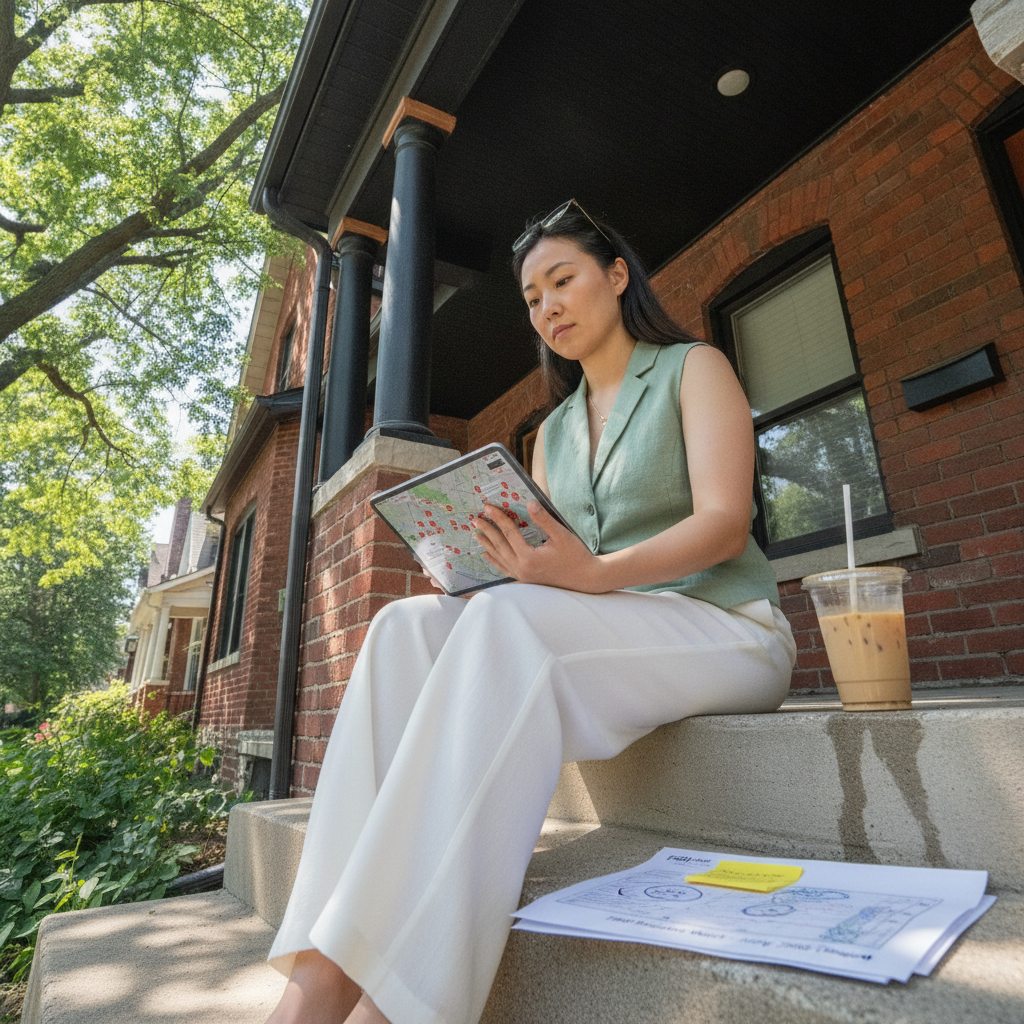
If you have been waiting on the sidelines for GTA property prices to drop further, the latest figures from the Toronto Regional Real Estate Board (TRREB) show the window for aggressive aggressive lowball offers is closing fast. Resale inventory is contracting, sales are holding steady, and average prices are establishing a firm floor across the region.
In the July 2026 TRREB market, GTA Realtors reported 5,995 home sales, down just 0.9% year-over-year. However, new listings plunged 17.8% to 14,484 while active listings dropped 12.1% to 26,098 properties. Average selling prices landed at $1,003,956; while that is down 4.5% compared to July 2025, seasonally adjusted benchmark prices actually edged upward from June. TRREB President Daniel Steinfeld pointed out that because active listings are absorbing faster than sellers are listing, buyers are losing negotiation room as the market trends back toward balance ahead of the fall.
What the July 2026 TRREB Market Data Means for Buyers
During the spring, extra inventory gave purchasers plenty of room to negotiate seller concessions and insert conditional financing clauses. But looking back at earlier GTA market shifts, supply pullbacks usually signal that price stability is returning.
Fewer new listings mean you are competing against other buyers for a smaller slice of quality move-in ready homes. While bidding wars are not back to pandemic heights, well-priced detached homes and townhouses are receiving fast offers again. Waiting until late autumn could mean paying slightly more while choosing from even fewer available listings.
Smart Financing Strategies for Today’s GTA Buyer
To win in a tightening market without overstretching your budget, you need your mortgage strategy sorted out before writing an offer. Federal rules give buyers more flexibility than in years past, provided you structure your financing correctly.
1. Use Federal Down Payment Rules to Your Advantage
Under current rules, the cap for high-ratio mortgage default insurance is $1,500,000. For homes priced under $1.5 million, you do not need a 20% down payment. You can put down 5% on the portion up to $500,000 and 10% on the portion between $500,000 and $1,499,999.
Say you are eyeing a detached starter home priced at $1,000,000. Your minimum down payment is exactly $75,000 ($25,000 on the first $500k plus $50,000 on the second $500k). On a $1,400,000 purchase, your minimum down payment comes to $115,000. Once a purchase price hits or exceeds $1,500,000, default insurance is unavailable, meaning an uninsured mortgage with a full 20% down payment ($300,000+) is required.
| Purchase Price | Minimum Down Payment | Mortgage Insurance Status | Max Amortization Options |
|---|---|---|---|
| $1,000,000 | $75,000 (7.5%) | Insured Eligible | 25 yrs (30 yrs for FTHB or new build) |
| $1,400,000 | $115,000 (8.2%) | Insured Eligible | 25 yrs (30 yrs for FTHB or new build) |
| $1,500,000 or more | $300,000+ (20%) | Uninsured / Conventional | Standard lender limits (up to 30 yrs) |
2. Reduce Monthly Payments with 30-Year Amortizations
Insured mortgages can now carry a 30-year amortization if you meet one of two criteria: you are a first-time home buyer on any property type, or you are buying a newly constructed home regardless of buyer status. Spreading repayments over 30 years lowers monthly cash outflows significantly, making qualification easier under the federal stress test (where borrowers must qualify at contract rate plus 2.0% or 5.25%, whichever is higher).
3. Tap Into New-Build GST/HST Rebates
If you opt for a new-build property as your primary residence, remember that eligible first-time buyers receive a full rebate on the federal GST portion for homes priced up to $1,000,000, and a partial rebate up to $50,000 for homes priced between $1,000,000 and $1,500,000. Combined with 30-year amortizations, purchasing a newly constructed home can save thousands upfront and monthly.
Our Take: What We Tell Clients at Canadian Mortgage Services
Here is what we tell people when they ask if they should wait until winter. Trying to time the exact bottom of the housing cycle rarely works. Active inventory dropped more than 12% in July alone while sales remained flat. When supply shrinks and demand stays steady, prices do not stay discounted for long.
If you are looking to move up from an existing home or purchase a property, working with an experienced licensed mortgage broker in Oakville or Brampton helps you secure a formal approval rather than a simple online estimate. If your existing property takes longer to close than your purchase, using bridge financing in Oakville keeps your move seamless without risking your transaction. Exploring custom Oakville mortgage solutions gives you access to over 40 wholesale lenders who compete for your business.
Frequently Asked Questions
What happened to listings in the July 2026 TRREB market?
New listings fell 17.8% year-over-year to 14,484 while active listings shrank 12.1% to 26,098. Because fewer sellers listed homes while sales held steady at 5,995, available inventory was absorbed faster, tightening market conditions across the GTA.
How much down payment do I need for a $1,000,000 GTA home?
Under insured mortgage rules, a $1,000,000 home requires a minimum down payment of $75,000. That equals 5% on the first $500,000 ($25,000) plus 10% on the remaining $500,000 ($50,000).
Who qualifies for a 30-year insured mortgage in Canada?
A 30-year amortization on an insured mortgage is available to all first-time home buyers purchasing any property type, and to all buyers purchasing newly constructed homes regardless of whether they have owned before.
Is the mortgage stress test required when renewing with a new lender?
If you perform a straight, stand-alone uninsured renewal switch between federally regulated lenders, OSFI guidelines exempt you from re-taking the stress test. However, refinancing or changing loan terms requires qualifying under standard stress test guidelines.
Ready to lock in your financing before GTA inventory tightens further? Reach out to Canadian Mortgage Services or call us at 905-455-5005 to discuss your options today.
About the Author: Neil Drepaul in
 Neil Drepaul is a Co-Owner and Mortgage Broker at Canadian Mortgage Services. With over 13 years of experience in the Canadian lending industry, Neil brings a strong entrepreneurial spirit to every client interaction. He specializes in helping homeowners and buyers find mortgage solutions that fit their real-life goals, not just their paperwork. His approach is straightforward: serve others first, and success follows.
