
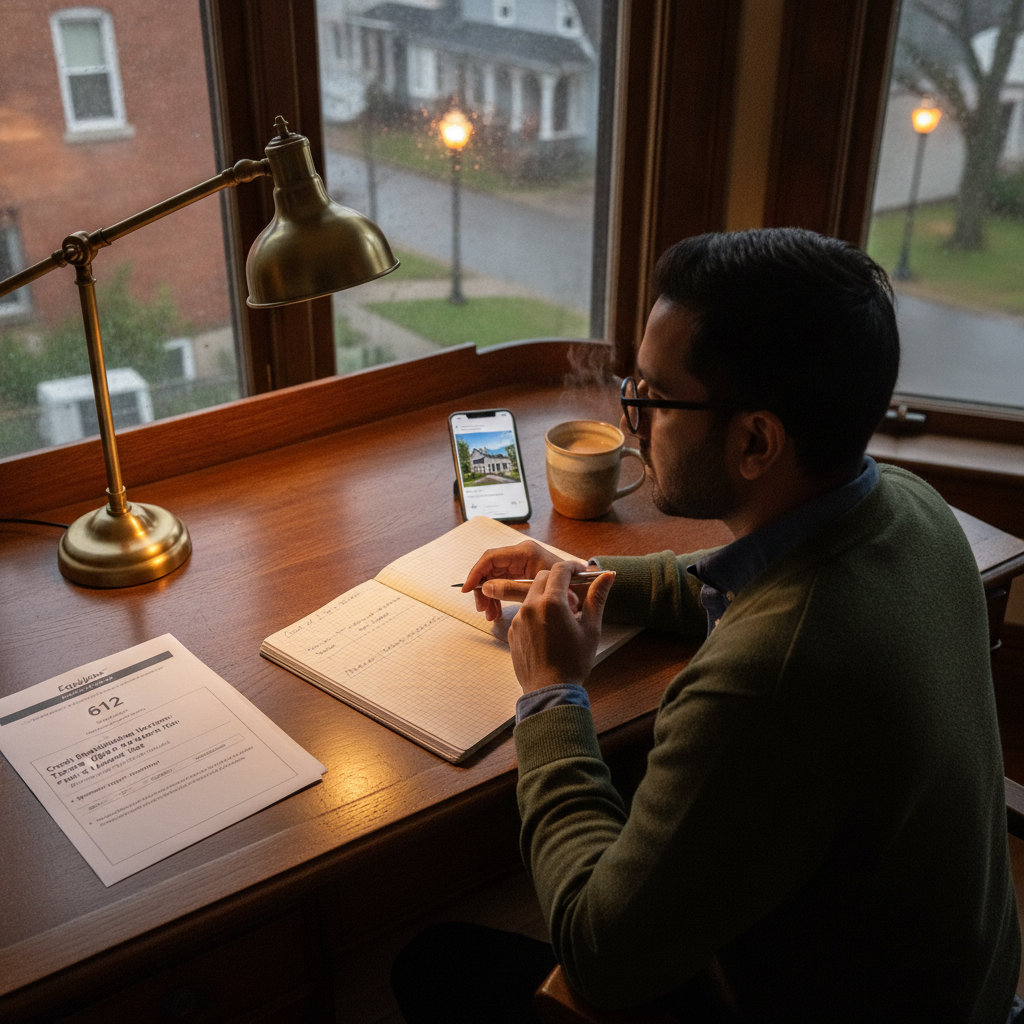
Taking a B-lender mortgage makes sense when the financial cost of waiting exceeds the extra interest and lender fees of a short-term alternative loan. If your mortgage is up for renewal, or if delaying a home purchase risks getting priced out of an inventory-tight market, accepting a one-year or two-year alternative mortgage often preserves your homeownership while you repair your credit score.
- The Waiting Dilemma in Ontario’s Credit Climate
- Running the Real Math: B-Lender Cost vs. Waiting 12 Months
- When to Take the B-Lender and When to Wait
- Our Take: The Temporary Bridge Strategy
- The 12-to-24 Month Roadmap Back to Prime Banks
- Frequently Asked Questions
- Short-term solution: A B-lender mortgage is an interim bridge (usually 1 to 2 years), never a permanent financing fixture.
- Down payment baseline: B-lenders require uninsured financing, meaning you need at least 20% down payment or built-up home equity.
- The cost of delay: Rebuilding a bruised credit score takes 6 to 18 months, during which home prices, listing supply, or mortgage renewal deadlines keep moving.
- Stress test reality: With the Bank of Canada holding the overnight rate at 2.25% (prime at 4.45%), prime bank stress tests sit near 6.50%, making alternative lender qualification ratios a practical lifeline.
The Waiting Dilemma in Ontario’s Credit Climate
Ontario households have felt steady financial pressure over recent years. According to Equifax Canada’s Q2 2026 Market Pulse report, the 90+ day non-mortgage delinquency rate among Ontario mortgage holders rose 27% year-over-year to 0.86%. Mortgage delinquencies across the province have climbed quarter after quarter. A missed car payment, carried credit card balances, or a dispute on a cell phone bill can quickly drag your credit score below the 680 benchmark prime lenders demand.
When an A-lender like a Big Six bank turns you down, you face an immediate choice. You can hit pause for 6 to 12 months, cut spending, dispute credit bureau errors, and hope your score recovers. Or you can work with alternative mortgage lenders in Canada who evaluate your equity and ability to repay rather than judging you solely on an automated credit algorithm.
Waiting sounds prudent on paper because prime interest rates are lower. But waiting also assumes the property market stays frozen while your score slowly climbs. In reality, inventory shifts quickly. For instance, TRREB reported GTA new listings fell 14.1% year-over-year in August 2026 to 12,075, keeping buyers competing over available homes even as the average GTA selling price sat at $993,410. In pockets like Scarborough, delaying a purchase while saving an extra couple of points on credit can mean facing tighter housing supply and rising values six months later.
Running the Real Math: B-Lender Cost vs. Waiting 12 Months
To make the right choice, you need to look past headline interest rates and inspect the total dollars out of pocket. Alternative lenders generally charge a 1% lender fee and higher contract rates than prime institutions. Fixed terms for B-lenders in Ontario in 2026 typically land between 5.14% and 6.49% for 1- to 2-year terms.
Let’s look at a realistic scenario. Picture a buyer purchasing a home with an $800,000 mortgage balance (meaning at least a 20% down payment of $200,000 on a $1,000,000 property). Option A uses a 1-year B-lender mortgage right away. Option B puts the purchase on hold for 12 months to fix credit, while the home price grows by a modest 3%.
| Cost Element | Option A: 1-Year B-Lender Today | Option B: Wait 12 Months for Prime |
|---|---|---|
| Mortgage Amount | $800,000 | $824,000 (after 3% property price rise) |
| Interest Rate | 5.89% (B-lender 1-year fixed) | 4.39% (Projected prime 5-year fixed) |
| 1% Lender Fee | $8,000 | $0 |
| Annual Interest Cost (Year 1) | ~$46,300 | $0 (Renting / waiting) |
| Cost of Waiting / Added Debt | $0 | $24,000 higher mortgage principal + rent paid |
| Status After 12 Months | Property secured; credit rebuilt; ready to switch to prime | Must qualify for a larger mortgage on a costlier home |
In this scenario, paying an $8,000 lender fee and roughly $12,000 in additional interest during Year 1 costs about $20,000 extra. But waiting 12 months in an appreciating market adds $24,000 directly onto the required mortgage balance. That added mortgage balance remains with you for 25 or 30 years, accompanied by a year of lost home equity.
When to Take the B-Lender and When to Wait
Every borrower’s balance sheet tells a different story. If you need a bad credit mortgage solution, here is how to determine which path makes financial sense.
Take the B-Lender Mortgage Right Now If:
Your current mortgage renewal is non-negotiable and your existing lender refuses to renew or demands an extortionate private rate. Because of OSFI guidelines, uninsured renewal switches between federally regulated lenders bypass the stress test only if you do a straight switch. If you need to consolidate unsecured debt to survive, an alternative lender provides immediate breathing room.
You have found a home at a favorable price, you hold at least 20% down payment, and waiting would mean losing the property or falling victim to shifting inventory.
Your credit score drops stem from isolated, explainable events like a resolved dispute, collections that are now settled, or temporary income interruptions that are back on track.
Hit Pause and Fix Your Credit First If:
You have less than 20% down payment. B-lenders operate in the uninsured lending space. By Canadian mortgage rules, default insurance from CMHC, Sagen, or Canada Guaranty is mandatory for down payments under 20% (up to the $1,500,000 insured purchase cap). If you only have 5% to 10% down, an alternative mortgage is simply off the table until you save more equity.
Your credit score is within striking distance of prime approval (say, 660) and a simple 60-day fix, like paying down revolving balances below 30% of their limits, will push you into prime territory immediately.
You have ongoing, active collections or late payments that you have not yet stopped. Taking a B-lender loan before you fix cash-flow leaks only sets you up for trouble when that term ends.
Our Take: The Temporary Bridge Strategy
Here is what we actually tell clients who sit across from our desk. Treat a B-lender as a short toll road, never a final destination. We have been arranging financing across Ontario since 1988 through 40-plus lending relationships, and the biggest mistake we see borrowers make is accepting an alternative mortgage without an ironclad exit plan.
A B-lender should strictly serve as a 12- to 24-month tool to solve an immediate problem. It buys you the time required to demonstrate spotless payment habits, clear old trade lines, and raise your score. If an advisor sets you up with an alternative loan without outlining the specific steps to graduate you to an A-lender on day 366, walk away.
The 12-to-24 Month Roadmap Back to Prime Banks
Moving from an alternative lender back to a Big Six bank or a prime monoline lender requires execution from the day your mortgage funds. Follow this schedule to ensure your renewal heads to prime rates:
First, maintain flawless payment history on the new mortgage. A single 30-day late payment on your mortgage file will instantly kill your chances of switching to an A-lender at maturity.
Next, establish two active, re-established credit lines. If you wiped out old cards, open two secured credit cards immediately. Keep credit utilization strictly under 30% of the limit on each card. Pay the balances off entirely each statement cycle.
Finally, connect with a licensed brokerage at month nine of your term. When you work with a trusted mortgage broker serving Scarborough and the broader GTA, we begin assembling your switch application three months before your B-lender mortgage matures. That prevents last-minute renewal scrambles and ensures you switch directly into a prime rate.
Frequently Asked Questions
Does taking a B-lender mortgage hurt your credit score?
No, taking a B-lender mortgage does not hurt your credit rating. In fact, making on-time monthly payments on an alternative mortgage reports positively to Equifax and TransUnion, helping rebuild your overall credit profile over 12 to 24 months.
What credit score do alternative lenders require in Ontario?
Alternative lenders in Ontario frequently approve borrowers with credit scores ranging from 550 to 650, where major chartered banks routinely say no. They place heavier weight on property equity, employment stability, and debt serviceability than on credit scores alone.
Can I get out of a B-lender mortgage early if my credit improves quickly?
Yes, but you must factor in prepayment penalties. Most B-lender mortgages carry a standard prepayment penalty, usually three months of interest, if broken before maturity. For this reason, we generally set borrowers up with 1-year terms if credit repair can be completed within 12 months.
How much equity do I need for an alternative mortgage?
You need a minimum of 20% equity or down payment, as alternative lenders do not offer government-backed insured mortgages. Maximum loan-to-value ratios typically cap out at 80%, though properties in rural areas may require 25% to 30% equity.
Weighing your options between repairing credit or moving forward with financing today? Talk through your numbers with our experienced team. Send us a message or call 905-455-5005 to build your mortgage roadmap.
About the Author: Neil Drepaul in
 Neil Drepaul is a Co-Owner and Mortgage Broker at Canadian Mortgage Services. With over 13 years of experience in the Canadian lending industry, Neil brings a strong entrepreneurial spirit to every client interaction. He specializes in helping homeowners and buyers find mortgage solutions that fit their real-life goals, not just their paperwork. His approach is straightforward: serve others first, and success follows.